The 500 Best Films Of All Time

An alphabetical list of films that really, really got my attention, from the art house to pop to poorly dubbed cult classics. Five hundred and thirty-six of them (and running) spanning from 1920-2025, including absolute favorites like Jean-Luc Godard’s Weekend, Lucrecia Martel’s Zama, Yorgos Lanthimos’ The Lobster, Jacques Tati’s Playtime, and Emir Kusturica’s Underground along with probably a handful of borderline movies. There’s precedent for unranked best film lists, as film critic Jonathan Rosenbaum offered one in 1998 as an alternative to the AFI’s top 100 film list with the rationale that ranking them would be “tantamount to ranking oranges over apples or declaring cherries superior to grapes.”
I also maintain a 100 Best Films of the 21st Century list and wrote some analysis about the NYT’s ‘Best Movies of the 21st Century’ list, released at the quarter century mark. Enjoy and reach out with any recommendation
The 500 Best Films of All Time List
(Alphabetized)
- Weekend (1967) Jean-Luc Godard’s apocalyptic masterpiece follows a bourgeois couple’s nightmarish road trip through a France descending into chaos and violence. Part satire, part political manifesto, the film abandons traditional narrative for a hallucinatory vision of consumer society’s collapse, featuring infamous tracking shots of traffic jams and escalating brutality that blur revolution and madness.
Zama (2017) Lucrecia Martel’s hypnotic adaptation of Antonio di Benedetto’s novel chronicles an 18th-century Spanish officer stranded in a remote South American outpost, waiting endlessly for a transfer that never comes. A fever dream of colonial decay, the film captures bureaucratic absurdity and existential despair with stunning visual precision and darkly comedic undertones.
8½ (1963) Federico Fellini’s autobiographical masterwork explores a creatively blocked film director retreating into memories, fantasies, and anxieties. A dazzling meditation on artistic creation, the film weaves reality and imagination into a deeply personal yet universal examination of identity, relationships, and the terror of the blank page. Marcello Mastroianni anchors the swirling baroque imagery.
Citizen Kane (1941) Orson Welles’ revolutionary debut remains cinema’s most influential achievement. The rise and fall of newspaper magnate Charles Foster Kane unfolds through fragmented perspectives, introducing groundbreaking techniques in cinematography, narrative structure, and sound design. Gregg Toland’s deep-focus photography and Bernard Herrmann’s score create an enduringly mysterious portrait of American ambition.
PlayTime (1967) Jacques Tati’s ambitious comedy transforms modern Paris into a gleaming labyrinth of glass and steel where technology frustrates human connection. Shot in 70mm with meticulously choreographed background gags, the film observes bumbling Monsieur Hulot navigating architectural nightmares and social rituals. A patient, almost dialogue-free masterpiece rewarding repeated viewing.
Underground (1995) Emir Kusturica’s epic black comedy spans fifty years of Yugoslav history through the absurd adventures of two friends exploiting war and revolution. Part carnival, part tragedy, the three-hour fever dream blends magical realism with biting political satire, set to a raucous brass band soundtrack that matches the film’s manic energy and emotional devastation.
Chinatown (1974) Roman Polanski’s neo-noir perfection casts Jack Nicholson as private detective Jake Gittes unraveling corruption in 1930s Los Angeles. Robert Towne’s screenplay weaves water rights, incest, and institutional evil into an immaculate mystery. Faye Dunaway’s wounded performance and the shocking finale cement this as the genre’s definitive modern statement.
2001: A Space Odyssey (1968) Stanley Kubrick’s enigmatic science fiction epic traces humanity’s evolution from ape to star child through encounters with mysterious monoliths. Combining groundbreaking visual effects, classical music, and minimal dialogue, the film creates a transcendent meditation on technology, consciousness, and our place in the cosmos that defies simple interpretation.
Mulholland Drive (2001) David Lynch’s Los Angeles nightmare begins as a Hollywood mystery before fracturing into dreamlike fragments. Naomi Watts delivers a stunning dual performance in a puzzle-box narrative exploring identity, desire, and delusion. The film’s haunting imagery and oblique storytelling create an atmosphere of dread and longing that lingers long after viewing.
The Lobster (2015) Yorgos Lanthimos’ dystopian comedy imagines a world where single people must find romantic partners within 45 days or be transformed into animals. Colin Farrell leads an absurdist examination of relationship conventions and societal pressure, delivered with deadpan dialogue and surreal logic. The film’s cold aesthetic perfectly matches its satirical critique.
Apocalypse Now (1979) Francis Ford Coppola’s Vietnam War epic sends Captain Willard upriver to assassinate a rogue colonel. Based loosely on Conrad’s “Heart of Darkness,” the film descends into madness alongside its protagonist, featuring Marlon Brando’s iconic Kurtz. The hallucinatory journey, troubled production, and operatic scope created a definitive vision of war’s insanity.
Fargo (1996) The Coen Brothers’ darkly comic crime story follows pregnant police chief Marge Gunderson investigating murders stemming from a kidnapping scheme gone wrong. Set against Minnesota’s frozen landscape, the film balances gruesome violence with folksy humor and genuine humanity. Frances McDormand’s Oscar-winning performance anchors the Coens’ most accessible masterpiece.
Caché (2005) Michael Haneke’s psychological thriller follows a bourgeois couple terrorized by anonymous videotapes surveilling their home. The mystery gradually reveals buried colonial guilt and personal complicity. Shot with unblinking static frames, the film implicates viewers in its uncomfortable examination of privilege, memory, and violence, culminating in an ambiguous final image.
Adaptation. (2002) Charlie Kaufman’s meta-fictional screenplay stars Nicolas Cage as Kaufman himself, struggling to adapt Susan Orlean’s “The Orchid Thief” while his twin brother writes a formulaic thriller. The film spirals through writer’s block, self-loathing, and increasingly absurd narrative choices, ultimately becoming the exact movie it mocks while remaining genuinely moving and hilarious.
La Dolce Vita (1960) Federico Fellini’s portrait of Roman decadence follows gossip journalist Marcello through seven days and nights of parties, affairs, and spiritual emptiness. Marcello Mastroianni embodies existential drift amid the celebrity culture and hedonism of Italy’s economic miracle. The film’s iconic imagery, especially Anita Ekberg in the Trevi Fountain, defines cinematic glamour.
La Chinoise (1967) Jean-Luc Godard’s prescient examination of radical politics observes five Parisian students forming a Maoist cell in a bright apartment. Shot in bold primary colors with theatrical staging, the film dissects revolutionary rhetoric and ideological certainty one year before the 1968 uprisings. More essay than narrative, it remains provocatively relevant to political discourse.
Lost Highway (1997) David Lynch’s nightmarish puzzle begins with a jazz musician accused of murdering his wife, then inexplicably transforms into a different person and story. The film’s fractured identity crisis, industrial soundtrack, and genuinely disturbing imagery create an atmosphere of paranoid dread. Lynch offers no easy answers to the reality-bending mystery.
L’Avventura (1960) Michelangelo Antonioni’s controversial breakthrough follows characters searching for a woman who vanishes on a Mediterranean island, then gradually forgetting her. The film’s radical approach privileges mood and alienation over plot, examining bourgeois ennui through austere compositions and elliptical storytelling. Monica Vitti’s luminous presence anchors the existential mystery.
There Will Be Blood (2007) Paul Thomas Anderson’s epic chronicles oil prospector Daniel Plainview’s ruthless accumulation of wealth and power in early 20th-century California. Daniel Day-Lewis delivers a towering performance of capitalist ambition and misanthropic fury, set against stunning landscapes. Jonny Greenwood’s discordant score heightens the portrait of American greed and spiritual bankruptcy.
The Seventh Seal (1957) Ingmar Bergman’s medieval allegory follows a knight returning from the Crusades to plague-ravaged Sweden, playing chess with Death for his life. The iconic imagery frames profound questions about faith, mortality, and meaning in an indifferent universe. Max von Sydow’s existential crisis resonates beyond its historical setting into timeless spiritual inquiry.
La Strada (1954) Federico Fellini’s neorealist masterpiece follows simple-minded Gelsomina sold to brutish strongman Zampanò, traveling Italy’s roads with his circus act. Giulietta Masina’s luminous, clown-like performance transforms poverty into poetry. The film’s heartbreaking trajectory explores love, cruelty, and redemption with profound humanity, establishing Fellini’s distinctive vision beyond neorealism’s constraints.
Band of Outsiders (1964) Jean-Luc Godard’s playful crime film follows two aimless men convincing a young woman to help rob her aunt’s villa. Deliberately artificial and digressive, the film includes an impromptu dance sequence in a café and a race through the Louvre. Godard deconstructs genre conventions while creating something both coolly intellectual and genuinely romantic.
La Notte (1961) Michelangelo Antonioni’s portrait of marital dissolution follows a writer and his wife through one night at a Milanese party, their relationship crumbling amid intellectual society. Jeanne Moreau and Marcello Mastroianni embody elegant despair in this middle entry of Antonioni’s alienation trilogy. The film’s architectural frames mirror emotional distance and incommunicability.
Breathless (1960) Jean-Luc Godard’s revolutionary debut follows small-time criminal Michel and American student Patricia through Paris’s streets. Jump cuts, handheld cameras, and casual disregard for classical continuity created a new cinematic language. Jean-Paul Belmondo and Jean Seberg embody cool rebellion in this influential landmark that defined the French New Wave’s liberating energy.
Shadows in Paradise (1986) Aki Kaurismäki’s deadpan romance follows two lonely Helsinki workers finding tentative connection. Delivered with minimal dialogue and maximal melancholy, the film’s drab settings and emotional reticence create surprising warmth. Kaurismäki’s distinctive style—absurdist humor, working-class sympathy, and rock’n’roll soundtrack—begins taking shape in this early minimalist gem about ordinary alienation.
Contempt (1963) Jean-Luc Godard’s gorgeous meditation on cinema follows a screenwriter’s marriage collapsing during troubled production of an Odyssey adaptation. Brigitte Bardot and Michel Piccoli embody romantic disintegration against sun-drenched Capri locations. Fritz Lang plays himself in this layered examination of artistic compromise, featuring stunning Technicolor cinematography and Georges Delerue’s haunting score.
Juliet of the Spirits (1965) Federico Fellini’s first color film follows middle-aged Juliet exploring fantasy, sexuality, and independence after discovering her husband’s infidelity. The baroque imagery explodes with psychedelic visions, spirits, and memories. Giulietta Masina navigates psychological liberation through Fellini’s increasingly surreal visual language, creating an intensely personal exploration of feminine consciousness.
L’Eclisse (1962) Michelangelo Antonioni concludes his alienation trilogy with a translator ending one affair and beginning another in Rome’s modern developments. The film privileges empty spaces and architectural environments over character psychology. Its radical seven-minute finale abandons the protagonists entirely, observing empty streets in a stunning meditation on absence and human insignificance.
The Zone of Interest (2023) Jonathan Glazer’s chilling masterwork observes a Nazi commandant’s family living comfortably beside Auschwitz, the horror remaining just beyond their garden wall. Using fixed cameras and spatial sound design, the film creates unbearable tension through what remains unseen. A devastating examination of complicity, compartmentalization, and the banality of evil.
Nights of Cabiria (1957) Federico Fellini’s neorealist gem follows a naive Roman prostitute through episodes of hope and heartbreak, searching for love and dignity. Giulietta Masina’s extraordinary performance balances vulnerability and resilience, creating an unforgettable character. The film’s compassionate humanism influenced everything from French New Wave to Broadway, directly inspiring “Sweet Charity.”
The Plumber (1979) Peter Weir’s taut psychological thriller follows an intrusive plumber terrorizing a graduate student alone in her apartment. Shot for Australian television but released theatrically, the film builds claustrophobic tension through class dynamics and domestic invasion. Weir transforms mundane home repairs into primal anxiety, demonstrating the directorial control that would define his later work.
My Winnipeg (2007) Guy Maddin’s dreamy pseudo-documentary reimagines his hometown through personal mythology, recreating childhood memories with actors playing family members. Blending archival footage with staged recreation and poetic narration, the film creates a fever-dream portrait of place, memory, and maternal influence. Maddin’s distinctive aesthetic—scratched film, melodramatic staging—reaches hallucinatory heights.
Claire’s Knee (1970) Éric Rohmer’s moral tale follows a diplomat spending summer at Lake Annecy, becoming obsessed with touching a teenage girl’s knee before his wedding. Rohmer’s characteristic verbal precision examines desire, self-deception, and intellectual rationalization. The film’s casual cruelty and beautiful locations create a deceptively light exploration of male fantasy and manipulation.
Rushmore (1998) Wes Anderson’s breakthrough comedy follows precocious 15-year-old Max Fischer at an elite prep school, locked in competition with industrialist Herman Blume for teacher Rosemary’s affection. Jason Schwartzman and Bill Murray create endearing misfits in Anderson’s precisely composed world of theatrical productions, revenge schemes, and wounded hearts seeking connection.
Masculin Féminin (1966) Jean-Luc Godard’s examination of youth culture follows young Parisians navigating love, politics, and pop music in mid-60s France. Structured as “15 precise facts,” the film observes consumer society and revolutionary posturing through interviews, café conversations, and intimate moments. Godard captures generational confusion and idealism in a documentary-fiction hybrid defining the zeitgeist.
The Big Lebowski (1998) The Coen Brothers’ stoner noir follows “The Dude,” a laid-back Los Angeles slacker mistaken for a millionaire, dragged into a convoluted kidnapping plot. Jeff Bridges anchors an unforgettable ensemble cast navigating absurdist comedy, bowling, and White Russians. The film’s quotable dialogue and shaggy-dog narrative have achieved cult status and endless rewatchability.
Last Year at Marienbad (1961) Alain Resnais’ enigmatic masterpiece unfolds in a baroque hotel where a man insists he met a woman the previous year, though she denies it. Reality and memory blur through hypnotic tracking shots, repetitive dialogue, and impossible architecture. The film’s radical rejection of linear narrative creates a haunting meditation on time and consciousness.
Blade Runner (1982) Ridley Scott’s influential science fiction noir follows a detective hunting rogue replicants in 2019 Los Angeles. The film’s rain-soaked, neon-drenched cyberpunk aesthetic defined the genre’s visual language. Rutger Hauer’s poignant final monologue and Vangelis’ synthesizer score enhance philosophical questions about humanity, memory, and mortality in this dystopian masterpiece.
Raging Bull (1980) Martin Scorsese’s brutal biography chronicles boxer Jake LaMotta’s rise and self-destruction. Robert De Niro’s transformative performance captures animal fury and psychological complexity. Shot in stark black-and-white with visceral fight sequences and domestic violence, the film examines toxic masculinity and self-loathing with unflinching honesty and visual poetry.
My Night at Maud’s (1969) Éric Rohmer’s third moral tale follows a Catholic engineer spending a snowy night conversing with divorced intellectual Maud, testing his principles before meeting his ideal woman. The film’s extended philosophical dialogue about Pascal’s wager, faith, and choice creates intellectual romance. Rohmer finds profound drama in talk, coincidence, and unspoken desire.
Knife in the Water (1962) Roman Polanski’s tense debut confines a married couple and young hitchhiker on a sailboat for a weekend, psychological games escalating toward violence. The minimalist three-character chamber piece explores class resentment, sexual tension, and masculine competition. Polanski demonstrates complete control over confined space, creating claustrophobic menace from seemingly casual interactions.
Corsage (2022) Marie Kreutzer’s revisionist portrait follows Empress Elisabeth of Austria approaching her 40th birthday in 1877, rebelling against court constraints and her ornamental existence. Vicky Krieps delivers a fierce, anachronistic performance that challenges historical prestige conventions. The film examines aging, beauty standards, and female agency with punk-rock irreverence and contemporary resonance.
Prospero’s Books (1991) Peter Greenaway’s radical Shakespeare adaptation reimagines “The Tempest” through elaborate visual layering, with John Gielgud’s Prospero speaking all characters’ lines initially. Combining high-definition video, Baroque painting references, and elaborate nudity, the film creates overwhelming sensory experience. Greenaway’s signature maximalist aesthetic reaches its most uncompromising, divisive extreme.
Careful (1992) Guy Maddin’s Alpine absurdist comedy unfolds in a mountain village where residents speak in whispers to avoid avalanches. Shot to resemble aged silent cinema with deliberately artificial sets and melodramatic performances, the film involves incest, repression, and Freudian symbolism. Maddin’s distinctive aesthetic creates a deliriously strange period piece about civilized restraint.
Blue Velvet (1986) David Lynch’s nightmarish suburban noir follows a college student discovering a severed ear, descending into a sadomasochistic underworld beneath his hometown’s white-picket-fence surface. Dennis Hopper’s terrifying Frank Booth and Isabella Rossellini’s damaged Dorothy create visceral horror and beauty. Lynch exposes American innocence as thin veneer over perverse violence.
The Life Aquatic with Steve Zissou (2004) Wes Anderson’s melancholic comedy follows an oceanographer seeking revenge on the shark that ate his partner. Bill Murray anchors the deadpan ensemble aboard a research vessel populated by misfits and family drama. Anderson’s meticulous production design, Seu Jorge’s Bowie covers, and stop-motion sea creatures create a moving elegy for obsolescence.
Funny Games (2007) Michael Haneke’s frame-by-frame English remake of his 1997 Austrian original follows a family tortured by two polite young men at their vacation home. The film implicates viewers in violence consumption through fourth-wall breaks and audience manipulation. Haneke’s clinical approach creates unbearable tension while critiquing our relationship with screen brutality.
Naked (1993) Mike Leigh’s caustic masterpiece follows misanthropic drifter Johnny raging through London’s streets, delivering apocalyptic monologues to everyone he encounters. David Thewlis gives a scorching performance balancing verbal brilliance with emotional violence. Leigh’s improvised approach captures nihilistic despair and intellectual fury in this pitch-black portrait of Thatcherism’s casualties.
Pulp Fiction (1994) Quentin Tarantino’s breakthrough interweaves multiple crime stories with fractured chronology, pop culture references, and razor-sharp dialogue. The ensemble cast—John Travolta’s career resurrection, Uma Thurman’s twist contest, Samuel L. Jackson’s Biblical hitman—inhabits a heightened reality of diners, briefcases, and vintage soundtrack. Revolutionary structure influenced countless imitators, never matched.
Man Bites Dog (1992) This Belgian mockumentary follows a film crew documenting a charismatic serial killer’s daily routines and murders. The pitch-black satire examines media complicity and audience fascination with violence as the filmmakers become increasingly involved in crimes. Shot in grainy black-and-white, the film’s transgressive premise creates uncomfortable questions about documentary ethics.
Adaptation (Jonze, 2002)†
Adjuster, The (Egoyan, 1992)
Adventures Of Baron Munchausen, The (Gilliam, 1988)
Accidental Tourist, The (Kasdan, 1988)†
After Hours (Scorsese, 1985)
Age of Innocence, The (Scorsese, 1993)†
Aguirre, The Wrath Of God (Herzog, 1972)
Alien (Scott, 1979)†
All We Imagine as Light (Kapadi, 2024)
Alphaville (Godard, 1965)
Alps (Lanthimos, 2011)
Amarcord (Fellini, 1973)
American Movie (Smith, 1999)
American Psycho (Harron, 2000)†
Amour Fou (Hausner, 2014)
Anatomy Of A Fall (Triet, 2023)
Angel At My Table, An (Campion, 1990)§
Annie Hall (Allen, 1977)
Apocalypse Now (Coppola, 1979)†
Artist, The (Hazanavicius, 2011)
Asteroid City (Anderson, 2023)
Attenberg (Tsangari, 2010)
Bad Lieutenant (Ferrara, 1992)
Bad Lieutenant: Port of Call – New Orleans (Herzog, 2009)
Badlands (Malick, 1973)
Balance of Improbabilities (Ramírez, 2021)
Band Of Outsiders (Godard, 1964)
Banshees Of Inisherin, The (McDonagh, 2022)
Barcelona (Stillman, 1994)
Barry Lyndon (Kubrick, 1975)†
Barton Fink (Coens, 1991)
Battleship Potemkin (Eisenstein, 1925)
Beanpole (Balagov, 2019)
Bed and Board (Truffaut, 1970)
Beetlejuice (Burton, 1988)
Before The Devil Knows You’re Dead (Lumet, 2007)
Before Sunrise (Linklater, 1995)
Beginners (Mills, 2010)
Being John Malkovich (Jonze, 1999)
Berberian Sound Studio (Strickland, 2012)
Bergman Island (Hansen-Løve, 2021)
Bicycle Thieves (De Sica, 1948)
Big Chill, The (Kasdan, 1983)
Big Fish (Burton, 2003)†
Big Lebowski, The (Coens, 1998)
Big Short, The (McKay, 2015)
Bird With The Crystal Plumage, The (Argento, 1970)†
Birdman (Inarritu, 2014)
Birds Without Feathers (McColm, 2018)
Birth (Glazer, 2004)
Bitter Tears of Petra von Kant, The (Fassbinder, 1972)
Black Swan (Aronofsky, 2010)
Blade Runner (Scott, 1982)†
Blood Simple (Coens, 1985)
Bloody Child, The (Menkes, 1996)
Blow Out (De Palma, 1981)
Blow Up (Antonioni, 1966)
Blue (Kieślowski, 1993)
Blue Velvet (Lynch, 1986)
Body Double (De Palma, 1984)
Boogie Nights (Anderson, 1997)
Borat (Charles, 2006)
Borat Subsequent Moviefilm (Woliner, 2020)
Bottle Rocket (Anderson, 1995)
Bound (Wachowskis, 1996)
Bowling For Columbine (Moore, 2002)
Boy Meets Girl (Carax, 1984)
Boys Don’t Cry (Peirce, 1999)
Boyz N The Hood (Singleton, 1991)
Brazil (Gilliam, 1985)
Breathless (Godard, 1960)
Breaking The Waves (von Trier, 1996)
Bright Star (Campion, 2009)§
Broadcast News (Brooks, 1987)
Broadway Danny Rose (Allen, 1984)
Broken Flowers (Jarmusch, 2005)
Buena Vista Social Club (Wenders, 1999)
Buffalo ’66 (Gallo, 1998)
Burden of Dreams (Blank, 1982)
Cabinet Of Dr. Caligari (Wiene, 1920)
Caché (Haneke, 2005)
Camaleón (Ramírez, 2017)
Cameraperson (Johnson, 2016)
Camille Claudel (Nuytten, 1988)
Cape Fear (Scorsese, 1991)†
Captive, La (Akerman, 2000)†
Capturing The Friedmans (Jarecki, 2003)
Career Girls (Leigh, 1997)
Careful (Maddin, 1992)
Chevalier (Tsangari, 2015)
Chinatown (Polanski, 1974)
Chloe (Egoyan, 2009)
Chuck & Buck (Arteta, 2000)
Cinema Paradiso (Tornatore, 1990)
Citizen Kane (Welles, 1941)
Citizen Ruth (Payne, 1996)
City Of Lost Children, The (Caro + Jeunet, 1995)
Civil Dead, The (Tatum, 2022)
Claire’s Knee (Rohmer, 1970)
Clockwork Orange, A (Kubrick, 1971)†
Code Unknown (Haneke, 2000)
Coffee and Cigarettes (Jarmusch, 2003)
Cold War (Pawlikowski, 2018)
Contempt (Godard, 1963)†
Conversation, The (Coppola, 1974)
Cook, The Thief, His Wife & Her Lover, The (Greenaway, 1989)
Corporation, The (Achbar, 2003)
Corsage (Kreutzer, 2022)
Crash (Cronenberg, 1996)†
Cremaster Cycle, The (Barney, 1994)
Crimes And Misdemeanors (Allen, 1989)
Crimewave (Raimi, 1985)
Croupier (Hodges, 1998)
Crying Game, The (Jordan, 1992)
Daisies (Chytilová, 1966)
Dancer In The Dark (von Trier, 2000)
Dead Man (Jarmusch, 1995)
Death And The Maiden (Polanski, 1994)‡
Deconstructing Harry (Allen, 1997)
Deep Red (Argento, 1975)
Deerskin (Dupieux, 2019)
DePalma (Baumbach + Paltrow, 2015)
Departed, The (Scorsese, 2006)
Delicatessen (Cano + Jeunet, 1991)
Dial M For Murder (Hitchcock, 1954)‡
Different Man, A (Schimberg, 2024)
Discreet Charm of the Bourgeoisie, The (Buñuel, 1972)
District 9 (Blomkamp, 2009)
Django Unchained (Tarantino, 2012)
Do The Right Thing (Lee, 1989)
Dogtooth (Lanthimos, 2009)
Dogville (von Trier, 2003)
Donnie Darko (Kelly, 2001)
Doors, The: Live at the Bowl ’68 (Manzarek, 1987)
Double Indemnity (Wilder, 1944)†
Double Life Of Veronique, The (Kieślowski, 1991)
Down By Law (Jarmusch, 1986)
Dr. Strangelove (Kubrick, 1964)†
Draughtsman’s Contract, The (Greenaway, 1982)
Dreams (Kurosawa, 1990)
Drifting Clouds (Kaurismäki, 1996)
Drugstore Cowboy (Van Sant, 1989)§
Duke Of Burgundy, The (Strickland, 2014)
Dune (Lynch, 1984)†
Dune (Villeneuve, 2021)†
Dunkirk (Nolan, 2017)
Easy Girl, An (Zlotowski, 2019)
Ed Wood (Burton, 1994)
Edward Scissorhands (Burton, 1990)
Eileen (Oldroyd, 2023)†
Election (Payne, 1999)†
Elizabeth (Kapur, 1998)
Empire Strikes Back, The (Kershner, 1980)
End Of The Affair, The (Jordan, 1999)†
Eternal Beauty (Roberts, 2019)
Eternal Sunshine Of The Spotless Mind (Gondry, 2004)
Europa (von Trier, 1991)
Eyes Wide Shut (Kubrick, 1999)†
Ex Machina (Garland, 2014)
Existenz (Cronenberg, 1999)
Exotica (Egoyan, 1994)
F is for Fake (Welles, 1973)
Fairy, The (Abel, Gordon, + Romy, 2011)
Fallen Leaves (Kaurismaki, 2023)
Fargo (Coens, 1996)
Favourite, The (Lanthimos, 2018)
Fellowship Of The Ring, The (Jackson, 2001)†
Fight Club (Fincher, 1999)
Fire Walk With Me (Lynch, 1992)
Fish Called Wanda, A (Crichton, 1988)
Fisher King, The (Gilliam, 1991)
Fly, The (Cronenberg, 1986)†
Flux Gourmet (Strickland, 2022)
Forbidden Room, The (Maddin, 2015)
France (Dumont, 2021)
Frances Ferguson (Byington, 2019)
Frances Ha (Baumbach, 2012)
French Dispatch, The (Anderson, 2021)
Frenzy (Hitchcock, 1972)
From Russia With Love (Young, 1963)†
Funny Games (Haneke, 2007)
Funny Ha Ha (Bujalski, 2002)
General, The (Keaton, 1926)
Gentlemen Broncos (Hess, 2009)
Ghost Dog (Jarmusch, 1999)
Ghost World (Zwigoff, 2001)†
Ghost Writer, The (Polanski, 2010)†
Gimme Danger (Jarmusch, 2016)
Glengarry Glen Ross (Foley, 1992)‡
Godfather, The (Coppola, 1972)†
Godfather Part II, The (Coppola, 1974)†
Gone With The Wind (Fleming, 1939)†
Goodfellas (Scorsese, 1990)§
Grand Budapest Hotel, The (Anderson, 2014)
Green Ray, The (Rohmer, 1986)
Grey Gardens (Maysles, 1975)
Greenberg (Baumbach, 2010)
Greener Grass (DeBoer + Luebbe, 2019)
Grifters, The (Frears, 1990)†
Grosse Pointe Blank (Armitage, 1997)
Grizzly Man (Herzog, 2005)
Hail, Caesar! (Coens, 2016)
Hannah And Her Sisters (Allen, 1986)
Happiness (Solondz, 1998)
Happy Go Lucky (Leigh, 2008)
Heat (Mann, 1995)
Heaven Adores You (Rossi, 2014)
Heavenly Creatures (Jackson, 1994)
Henry Fool (Hartley, 1997)
Hideous Kinky (MacKinnon, 1992)
Hit, The (Frears, 1984)
Holdovers, The (Payne, 2023)
Hollywood Shuffle (Witherspoon, 1987)
Holy Girl, The (Martel, 2004)
Holy Motors (Carax, 2012)
Host, The (Bong, 2006)
Hour Of The Wolf (Bergman, 1968)
House Of Games (Mamet, 1987)
House That Jack Built, The (von Trier, 2018)
Howards End (Ivory, 1992)†
Hudsucker Proxy (Coens, 1994)
I Called Him Morgan (Collin, 2016)
I Heart Huckabees (Russell, 2004)
I Love You To Death (Kasdan, 1990)
Idiocracy (Judge, 2006)
I’m Thinking Of Ending Things (Kaufman, 2020)†
In Bruges (McDonagh, 2008)
In Fabric (Strickland, 2018)
In My Room (Köhler, 2018)
In The Company Of Men (LaBute, 1997)‡
Inglorious Basterds (Tarantino, 2009)
Inland Empire (Lynch, 2006)
Insider, The (Mann, 1999)§
It’s Not Me (Carax, 2024)
Jabberwocky (Gilliam, 1971)
Jacob’s Ladder (Lyne, 1990)
Janet Planet (Baker, 2023)
Jazz (Burns, 2000)
Jeanne Dielman, 23 quai du Commerce, 1080 Bruxelles (Akerman, 1975)
Jerk, The (Reiner, 1979)
Juliet Of The Spirits (Fellini, 1965)
Kagero-za (Suzuki, 1981)†
Kajillionaire (July, 2020)
Keep An Eye Out (Dupieux, 2021)
Kicking And Screaming (Baumbach, 1995)
Kill Bill, Vol. 2 (Tarantino, 2004)
Killer, The (Fincher, 2023)
Killing Of A Sacred Deer, The (Lanthimos, 2017)
Kinds of Kindness (Lanthimos, 2024)
King Kong (Cooper, 1933)
King Kong (Jackson, 2005)
King Of Kong (Gordon, 2007)
Knife In The Water (Polanski, 1963)
LA Confidential (Hanson, 1997)
LA Story (Jackson, 1991)
L’Avventura (Antonioni, 1961)
L’eclisse (Antonioni, 1962)
La Chinoise (Godard, 1968)†
La Ciénaga (Martel, 2001)
La Collectionneuse (Rohmer, 1967)
La Dolce Vita (Fellini, 1960)
La Femme Nikita (Besson, 1990)
La Strada (Fellini, 1954)
Landlord, The (Ashby, 1970)
Last Days (Van Sant, 2005)
Last Picture Show, The (Bogdanovich, 1971)†
Last Temptation Of Christ, The (Scorsese, 1988)
Last Year At Marienbad (Resnais, 1962)
Le Petit Soldat (Godard, 1963)
Le Rendez-vous d’Anna (Akerman, 1978)
Le Samouraï (Melville, 1967)
Leon: The Professional (Besson, 1994)
Licorice Pizza (Anderson, 2021)
Life Aquatic With Steve Zissou, The (Anderson, 2004)
Life Of Brian (Jones, 1979)
Limey, The (Soderberg, 1999)
Listen Up, Philip (Perry, 2014)
Living In Oblivion (DeCillo, 1995)
Lobster, The (Lanthimos, 2015)
Lolita (Kubrick, 1962)†
Long Goodbye, The (Altman, 1973)†
Lost Daughter, The (Gyllenhaal, 2021)†
Lost Highway (Lynch, 1997)
Lost In Translation (Coppola, 2003)
Love & Friendship (Stillman, 2016)†
Love In The Afternoon (Rohmer, 1957)
Lovers on the Bridge, The (Carax, 1991)
M (Lang, 1931)
Macbeth (Kurzel, 2015)‡
Machinist, The (Anderson, 2004)
Mad Max (Miller, 1979)
Mad Max 2 (Miller, 1981)
Magnificent Ambersons, The (Welles, 1942)†
Magnolia (Anderson, 1999)
Malcolm X (Lee, 1992)§
Man Bites Dog (Belvaux, Bonzel + Poelvoorde, 1993)
Man On Wire (Marsh, 2008)
Mandibles (Dupieux, 2020)
Manhattan (Allen, 1979)
Manhattan Murder Mystery (Allen, 1993)
Manhunter (Mann, 1986)†
March of the Penguins (Jacquet, 2005)
Marty Supreme (Safdie, 2025)
Masculin Féminin (Godard, 1966)
M*A*S*H (Altman, 1970)†
Match Factory Girl, The (Kaurismäki, 1990)
May December (Haynes, 2023)
Mean Streets (Scorsese, 1973)
Melancholia (von Trier, 2011)
Memento (Nolan, 2000)
Metropolis (Lang, 1927)
Metropolitan (Stillman, 1990)
Miller’s Crossing (Coens, 1990)†
Mo’ Better Blues (Lee, 1990)
Mon Oncle (Tati, 1958)
Monty Python And The Holy Grail (Gilliam, 1975)
Moonrise Kingdom (Anderson, 2012)
Most Violent Year, A (Chandor, 2014)
Mountainhead (Armstrong, 2025)
Mr. Turner (Leigh, 2014)
Mulholland Drive (Lynch, 2001)
Mutual Appreciation (Bujalski, 2005)
My Best Fiend (Herzog, 1999)
My Brilliant Career (Armstrong, 1979)†
My Dinner With Andre (Malle, 1981)
My Left Foot (Sheridan, 1989)§
My Winnipeg (Maddin, 2007)
My Night At Maud’s (Rohmer, 1970)
My Own Private Idaho (Van Sant, 1991)‡
Mystery Train (Jarmusch, 1989)
Naked (Leigh, 1993)
Napoleon Dynamite (Hess, 2004)
Nashville (Altman, 1975)
Natural Born Killers (Stone, 1994)
Night On Earth (Jarmusch, 1992)
Nightcrawler (Gilroy, 2014)
Nights Of Cabiria (Fellini, 1957)
Ninth Gate, The (Polanski, 1999)†
No Country For Old Men (Coens, 2007)†
North By Northwest (Hitchcock, 1959)
Nosferatu (Murnau, 1922)†
Nostalgia (Martone, 2022)†
O Brother, Where Art Thou? (Coens, 2000)†
On Her Majesty’s Secret Service (Hunt, 1969)†
On The Waterfront (Kazan, 1954)§
Only Dream Things (Maddin, 2012)
Our Man In Havana (Reed, 1959)†
Out Of Sight (Soderberg, 1998)†
Out Of The Past (Tourneur, 1947)†
Palindromes (Solondz, 2004)
Pan’s Labyrinth (del Toro, 2006)
Parasite (Bong, 2019)
Paris, Texas (Wenders, 1984)
Passenger, The (Antonioni, 1975)
Pee-wee’s Big Adventure (Burton, 1985)
Persona (Bergman, 1966)
Peter von Kant (Ozon, 2022)
Phantom Love (Menkes, 2007)
Phantom Thread (Anderson, 2017)
Piales (Lebrija, 2019)
Piano, The (Campion, 1993)
Pillow Book, The (Greenaway, 1996)
Pink Floyd—The Wall (Parker, 1982)
Pity (Makridis, 2018)
Planet Of The Apes (Schaffner, 1968)†
Platoon (Stone, 1986)
Player, The (Altman, 1992)†
Playtime (Tati, 1967)
Plumber, The (Weir, 1979)
Portrait of a Lady on Fire (Sciamma, 2019)
Power Of The Dog, The (Campion, 2021)†
Prestige, The (Nolan, 2006)†
Pride & Prejudice (Langton, 1995)†
Pride & Prejudice (Wright, 2005)†
Princess Bride, The (Reiner, 1987)†
Private Property (Stevens, 1960)
Promise, The: The Making of Darkness on the Edge of Town (Zimny, 2010)
Promising Young Woman (Fennell, 2020)
Prospero’s Books (Greenaway, 1991)‡
Psycho (Hitchcock, 1960)†
Psycho (Van Sant, 1998)†
Pulp Fiction (Tarantino, 1994)
Pumping Iron (Butler, 1977)
Punch Drunk Love (Anderson, 2002)
Punishment Park (Watkins, 1971)
Purple Rose Of Cairo, The (Allen, 1985)
Putney Swope (Downey, Sr., 1969)
Queen of Diamonds (Menkes, (1991)
Raging Bull (Scorsese, 1980)§
Raiders Of The Lost Ark (Spielberg, 1981)
Raising Arizona (Coens, 1987)
Ran (Kurosawa, 1985)‡
Rashomon (Kurosawa, 1950)†
Reality (Dupieux, 2014)
Rear Window (Hitchcock, 1954)†
Red (Kieślowski, 1994)
Red Desert (Antonioni, 1964)
Red Rocket (Baker, 2021)
Red Rock West (Dahl, 1993)
Remains Of The Day (Ivory, 1989)†
Repulsion (Polanski, 1965)†
Reservoir Dogs (Tarantino, 1992)
Retrograde (Murray, 2022)
Return Of The King, The (Jackson, 2003)†
Requiem For A Dream (Aronofsky, 2000)
Robocop (Verhoeven, 1987)
Roger & Me (Moore, 1989)
Romper Stomper (Wright, 1992)
Room With A View, A (Ivory, 1985)†
Rosemary’s Baby (Polanski, 1968)
Rosencrantz & Guildenstern Are Dead (Stoppard, 1990)‡
Royal Tenenbaums, The (Anderson, 2001)
Rumble Fish (Coppola, 1983)†
Rushmore (Anderson, 1998)
Sans Soleil (Marker, 1983)
Safe (Haynes, 1995)
Satyricon (Fellini, 1969)
Savages, The (Jenkins, 2007)
Scarface (De Palma, 1983)†
Scarlet Street (Lang, 1945)†
Secrets & Lies (Leigh, 1996)
Sense And Sensibility (Lee, 1995)†
Serious Man, A (Coens, 2009)
Seven Samurai (Kurosawa, 1954)
Seventh Seal, The (Bergman, 1958)
Sex, Lies, And Videotape (Soderberg, 1989)
Sexy Beast (Glazer, 2001)
Shadows In Paradise (Kaurismäki, 1986)
Shape of Things, The (LaBute, 2003)
She’s Gotta Have It (Lee, 1986)
Sherlock Jr (Keaton, 1924)
Schindler’s List (Spielberg, 1993)†
Short Cuts (Altman, 1993)†
Sid And Nancy (Cox, 1986)
Sideways (Payne, 2004)†
Silence Of The Lambs, The (Demme, 1991)†
Sixteen Candles (Hughes, 1984)
Smoke (Wang, 1995)
Solaris (Soderberg, 2002)†
Sorry To Bother You (Riley, 2018)
Souvenir, The (Hogg, 2019)
Spider (Cronenberg, 2002)
Squid And The Whale, The (Baumbach, 2005)
Stalker (Tarkovsky, 1979)†
Stanleyville (McCabe-Lokos, 2021)
Star Wars (Lucas, 1977)
Stardust Memories (Allen, 1980)
Stars at Noon (Denis, 2022)
Starship Troopers (Verhoeven, 1997)†
Steep and Deep (Miller, 1985)
Strange Brew (Thomas, 1983)‡
Stranger Than Paradise (Jarmusch, 1984)
Strangers on a Train (Hitchcock, 1951)†
Storytelling (Solondz, 2001)
Sudden Fear (Miller, 1952)†
Susperia (Argento, 1977)
Sweet And Lowdown (Allen, 1999)
Sweet Hereafter, The (Egoyan, 1997)†
Swimming Pool (Ozon, 2003)
Swingers (Liman, 1996)
Synecdoche, NY (Kaufman, 2008)
Synonyms (Lapid, 2019)
Take, The (Lewis, 2004)
Tár (Field, 2022)
Taxi Driver (Scorsese, 1976)
Terms Of Endearment (Brooks, 1983)†
Tesnota (Balagov, 2017)
There Will Be Blood (Anderson, 2007)†
They’ll Love Me When I’m Dead (Neville, 2018)§
Things To Come (Hansen-Løve, 2016)
Third Man, The (Reed, 1949)
Three Billboards Outside Ebbing, Missouri (McDonaugh, 2017)
Thunderball (Young, 1965)†
THX 1138 (Coppola, 1971)
Tie Me Up! Tie Me Down! (Almodovar, 1989)
Time Bandits (Gilliam, 1981)
Tinker Tailor Soldier Spy (Alfredson, 2011)†
Tiny Furniture (Dunham, 2010)
To Die For (Van Sant, 1995)
Topsy-turvy (Leigh, 1999)
Touch Of Evil (Welles, 1958)†
Tragedy Of Macbeth, The (Coen, 2021)‡
Trainspotting (Boyle, 1996)†
Trees Lounge (Buscemi, 1996)
Triangle Of Sadness (Östlund, 2022)
Trip, The (Winterbottom, 2010)
True Romance (Scott, 1993)
Trust (Hartley, 1990)
Two Towers, The (Jackson, 2002)†
Under The Skin (Glazer, 2013)†
Underground (Kusturica, 1997)
Until The End Of The World (Wenders, 1991)
Untouchables, The (De Palma, 1987)§
Usual Suspects, The (Singer, 1995)
Vanya On 42nd Street (Malle, 1994)‡
Velvet Underground, The (Haynes, 2021)
Vera Drake (Leigh, 2004)
Vertigo (Hitchcock, 1958)†
Vice (McKay, 2018)
Vicky Cristina Barcelona (Allen, 2008)
Videodrome (Cronenberg, 1983)
Virgin Spring, The (Bergman, 1960)†
Virgin Suicides, The (Coppola, 1999)†
Wallace & Gromit: The Curse of the Were-Rabbit (Park & Box, 2005)
Wanda (Loden, 1970)
Wasp (Arnold, 2003)
Weekend (Godard, 1968)
Welcome To The Dollhouse (Solondz, 1995)
When We Were Kings (Gast, 1996)
White Noise (Baumbach, 2022)†
White Material (Denis, 2009)
Who Framed Roger Rabbit (Zemeckis, 1988)
Wild At Heart (Lynch, 1990)
Wings of Desire (Wenders, 1987)
Winter Flies (Omerzu, 2018)
Women On The Verge Of A Nervous Breakdown (Almodovar, 1988)
Women Talking (Polley, 2022)†
Worst Person in the World, The (Trier, 2021)
Wuthering Heights (Arnold, 2011)†
Year Of Living Dangerously, The (Weir, 1982)†
Yojimbo (Kurosawa, 1961)
You Were Never Really Here (Ramsay, 2017)
Young Frankenstein (Brooks, 1974)
Zabriskie Point (Antonioni, 1970)
Zama (Martel, 2017)†
Zed & Two Noughts, A (Greenaway, 1985)
Zelig (Allen, 1983)
Zero Effect (J Kasdan, 1998)†
Zone Of Interest, The (Glazer, 2023)†
12 Monkeys (Gilliam, 1995)
1984 (Radford, 1984)†
2001: A Space Odyssey (Kubrick, 1968)†
7 Chinese Brothers (Byington, 2015)
8 ½ (Fellini, 1963)
A Clockwork Orange (Kubrick, 1971)†
A Different Man (Schimberg, 2024)
A Fish Called Wanda (Crichton, 1988)
A Most Violent Year (Chandor, 2014)
A Room With A View (Ivory, 1985)†
A Serious Man (Coens, 2009)
Adaptation (Jonze, 2002)†
Adjuster, The (Egoyan, 1992)
Adventures Of Baron Munchausen, The (Gilliam, 1988)
Accidental Tourist, The (Kasdan, 1988)†
After Hours (Scorsese, 1985)
Age of Innocence, The (Scorsese, 1993)†
Aguirre, The Wrath Of God (Herzog, 1972)
Alien (Scott, 1979)†
All We Imagine as Light (Kapadi, 2024)
Alphaville (Godard, 1965)
Alps (Lanthimos, 2011)
Amarcord (Fellini, 1973)
American Movie (Smith, 1999)
American Psycho (Harron, 2000)†
Amour Fou (Hausner, 2014)
An Angel At My Table (Campion, 1990)§
An Easy Girl (Zlotowski, 2019)
Anatomy Of A Fall (Triet, 2023)
Annie Hall (Allen, 1977)
Apocalypse Now (Coppola, 1979)†
Artist, The (Hazanavicius, 2011)
Asteroid City (Anderson, 2023)
Attenberg (Tsangari, 2010)
Bad Lieutenant (Ferrara, 1992)
Bad Lieutenant: Port of Call – New Orleans (Herzog, 2009)
Badlands (Malick, 1973)
Balance of Improbabilities (Ramírez, 2021)
Band Of Outsiders (Godard, 1964)
Banshees Of Inisherin, The (McDonagh, 2022)
Barcelona (Stillman, 1994)
Barry Lyndon (Kubrick, 1975)†
Barton Fink (Coens, 1991)
Battleship Potemkin (Eisenstein, 1925)
Beanpole (Balagov, 2019)
Bed and Board (Truffaut, 1970)
Beetlejuice (Burton, 1988)
Before The Devil Knows You’re Dead (Lumet, 2007)
Before Sunrise (Linklater, 1995)
Beginners (Mills, 2010)
Being John Malkovich (Jonze, 1999)
Berberian Sound Studio (Strickland, 2012)
Bergman Island (Hansen-Løve, 2021)
Bicycle Thieves (De Sica, 1948)
Big Chill, The (Kasdan, 1983)
Big Fish (Burton, 2003)†
Big Lebowski, The (Coens, 1998)
Big Short, The (McKay, 2015)
Bird With The Crystal Plumage, The (Argento, 1970)†
Birdman (Inarritu, 2014)
Birds Without Feathers (McColm, 2018)
Birth (Glazer, 2004)
Bitter Tears of Petra von Kant, The (Fassbinder, 1972)
Black Swan (Aronofsky, 2010)
Blade Runner (Scott, 1982)†
Blood Simple (Coens, 1985)
Bloody Child, The (Menkes, 1996)
Blow Out (De Palma, 1981)
Blow Up (Antonioni, 1966)
Blue (Kieślowski, 1993)
Blue Velvet (Lynch, 1986)
Body Double (De Palma, 1984)
Boogie Nights (Anderson, 1997)
Borat (Charles, 2006)
Borat Subsequent Moviefilm (Woliner, 2020)
Bottle Rocket (Anderson, 1995)
Bound (Wachowskis, 1996)
Bowling For Columbine (Moore, 2002)
Boy Meets Girl (Carax, 1984)
Boys Don’t Cry (Peirce, 1999)
Boyz N The Hood (Singleton, 1991)
Brazil (Gilliam, 1985)
Breathless (Godard, 1960)
Breaking The Waves (von Trier, 1996)
Bright Star (Campion, 2009)§
Broadcast News (Brooks, 1987)
Broadway Danny Rose (Allen, 1984)
Broken Flowers (Jarmusch, 2005)
Buena Vista Social Club (Wenders, 1999)
Buffalo ’66 (Gallo, 1998)
Burden of Dreams (Blank, 1982)
Cabinet Of Dr. Caligari (Wiene, 1920)
Caché (Haneke, 2005)
Camaleón (Ramírez, 2017)
Cameraperson (Johnson, 2016)
Camille Claudel (Nuytten, 1988)
Cape Fear (Scorsese, 1991)†
Captive, La (Akerman, 2000)†
Capturing The Friedmans (Jarecki, 2003)
Career Girls (Leigh, 1997)
Careful (Maddin, 1992)
Chevalier (Tsangari, 2015)
Chinatown (Polanski, 1974)
Chloe (Egoyan, 2009)
Chuck & Buck (Arteta, 2000)
Cinema Paradiso (Tornatore, 1990)
Citizen Kane (Welles, 1941)
Citizen Ruth (Payne, 1996)
City Of Lost Children, The (Caro + Jeunet, 1995)
Civil Dead, The (Tatum, 2022)
Claire’s Knee (Rohmer, 1970)
Code Unknown (Haneke, 2000)
Coffee and Cigarettes (Jarmusch, 2003)
Cold War (Pawlikowski, 2018)
Contempt (Godard, 1963)†
Conversation, The (Coppola, 1974)
Cook, The Thief, His Wife & Her Lover, The (Greenaway, 1989)
Corporation, The (Achbar, 2003)
Corsage (Kreutzer, 2022)
Crash (Cronenberg, 1996)†
Cremaster Cycle, The (Barney, 1994)
Crimes And Misdemeanors (Allen, 1989)
Crimewave (Raimi, 1985)
Croupier (Hodges, 1998)
Crying Game, The (Jordan, 1992)
Daisies (Chytilová, 1966)
Dancer In The Dark (von Trier, 2000)
Dead Man (Jarmusch, 1995)
Death And The Maiden (Polanski, 1994)‡
Deconstructing Harry (Allen, 1997)
Deep Red (Argento, 1975)
Deerskin (Dupieux, 2019)
DePalma (Baumbach + Paltrow, 2015)
Departed, The (Scorsese, 2006)
Delicatessen (Cano + Jeunet, 1991)
Dial M For Murder (Hitchcock, 1954)‡
Discreet Charm of the Bourgeoisie, The (Buñuel, 1972)
District 9 (Blomkamp, 2009)
Django Unchained (Tarantino, 2012)
Do The Right Thing (Lee, 1989)
Dogtooth (Lanthimos, 2009)
Dogville (von Trier, 2003)
Donnie Darko (Kelly, 2001)
Doors, The: Live at the Bowl ’68 (Manzarek, 1987)
Double Indemnity (Wilder, 1944)†
Double Life Of Veronique, The (Kieślowski, 1991)
Down By Law (Jarmusch, 1986)
Dr. Strangelove (Kubrick, 1964)†
Draughtsman’s Contract, The (Greenaway, 1982)
Dreams (Kurosawa, 1990)
Drifting Clouds (Kaurismäki, 1996)
Drugstore Cowboy (Van Sant, 1989)§
Duke Of Burgundy, The (Strickland, 2014)
Dune (Lynch, 1984)†
Dune (Villeneuve, 2021)†
Dunkirk (Nolan, 2017)
Ed Wood (Burton, 1994)
Edward Scissorhands (Burton, 1990)
Eileen (Oldroyd, 2023)†
Election (Payne, 1999)†
Elizabeth (Kapur, 1998)
Empire Strikes Back, The (Kershner, 1980)
End Of The Affair, The (Jordan, 1999)†
Eternal Beauty (Roberts, 2019)
Eternal Sunshine Of The Spotless Mind (Gondry, 2004)
Europa (von Trier, 1991)
Eyes Wide Shut (Kubrick, 1999)†
Ex Machina (Garland, 2014)
Existenz (Cronenberg, 1999)
Exotica (Egoyan, 1994)
F is for Fake (Welles, 1973)
Fairy, The (Abel, Gordon, + Romy, 2011)
Fallen Leaves (Kaurismaki, 2023)
Fargo (Coens, 1996)
Favourite, The (Lanthimos, 2018)
Fellowship Of The Ring, The (Jackson, 2001)†
Fight Club (Fincher, 1999)
Fire Walk With Me (Lynch, 1992)
Fisher King, The (Gilliam, 1991)
Fly, The (Cronenberg, 1986)†
Flux Gourmet (Strickland, 2022)
Forbidden Room, The (Maddin, 2015)
France (Dumont, 2021)
Frances Ferguson (Byington, 2019)
Frances Ha (Baumbach, 2012)
French Dispatch, The (Anderson, 2021)
Frenzy (Hitchcock, 1972)
From Russia With Love (Young, 1963)†
Funny Games (Haneke, 2007)
Funny Ha Ha (Bujalski, 2002)
General, The (Keaton, 1926)
Gentlemen Broncos (Hess, 2009)
Ghost Dog (Jarmusch, 1999)
Ghost World (Zwigoff, 2001)†
Ghost Writer, The (Polanski, 2010)†
Gimme Danger (Jarmusch, 2016)
Glengarry Glen Ross (Foley, 1992)‡
Godfather, The (Coppola, 1972)†
Godfather Part II, The (Coppola, 1974)†
Gone With The Wind (Fleming, 1939)†
Goodfellas (Scorsese, 1990)§
Grand Budapest Hotel, The (Anderson, 2014)
Green Ray, The (Rohmer, 1986)
Grey Gardens (Maysles, 1975)
Greenberg (Baumbach, 2010)
Greener Grass (DeBoer + Luebbe, 2019)
Grifters, The (Frears, 1990)†
Grosse Pointe Blank (Armitage, 1997)
Grizzly Man (Herzog, 2005)
Hail, Caesar! (Coens, 2016)
Hannah And Her Sisters (Allen, 1986)
Happiness (Solondz, 1998)
Happy Go Lucky (Leigh, 2008)
Heat (Mann, 1995)
Heaven Adores You (Rossi, 2014)
Heavenly Creatures (Jackson, 1994)
Henry Fool (Hartley, 1997)
Hideous Kinky (MacKinnon, 1992)
Hit, The (Frears, 1984)
Holdovers, The (Payne, 2023)
Hollywood Shuffle (Witherspoon, 1987)
Holy Girl, The (Martel, 2004)
Holy Motors (Carax, 2012)
Host, The (Bong, 2006)
Hour Of The Wolf (Bergman, 1968)
House Of Games (Mamet, 1987)
House That Jack Built, The (von Trier, 2018)
Howards End (Ivory, 1992)†
Hudsucker Proxy (Coens, 1994)
I Called Him Morgan (Collin, 2016)
I Heart Huckabees (Russell, 2004)
I Love You To Death (Kasdan, 1990)
Idiocracy (Judge, 2006)
I’m Thinking Of Ending Things (Kaufman, 2020)†
In Bruges (McDonagh, 2008)
In Fabric (Strickland, 2018)
In My Room (Köhler, 2018)
In The Company Of Men (LaBute, 1997)‡
Inglorious Basterds (Tarantino, 2009)
Inland Empire (Lynch, 2006)
Insider, The (Mann, 1999)§
It’s Not Me (Carax, 2024)
Jabberwocky (Gilliam, 1971)
Jacob’s Ladder (Lyne, 1990)
Janet Planet (Baker, 2023)
Jazz (Burns, 2000)
Jeanne Dielman, 23 quai du Commerce, 1080 Bruxelles (Akerman, 1975)
Jerk, The (Reiner, 1979)
Juliet Of The Spirits (Fellini, 1965)
Kagero-za (Suzuki, 1981)†
Kajillionaire (July, 2020)
Keep An Eye Out (Dupieux, 2021)
Kicking And Screaming (Baumbach, 1995)
Kill Bill, Vol. 2 (Tarantino, 2004)
Killer, The (Fincher, 2023)
Killing Of A Sacred Deer, The (Lanthimos, 2017)
Kinds of Kindness (Lanthimos, 2024)
King Kong (Cooper, 1933)
King Kong (Jackson, 2005)
King Of Kong (Gordon, 2007)
Knife In The Water (Polanski, 1963)
LA Confidential (Hanson, 1997)
LA Story (Jackson, 1991)
L’Avventura (Antonioni, 1961)
L’eclisse (Antonioni, 1962)
La Chinoise (Godard, 1968)†
La Ciénaga (Martel, 2001)
La Collectionneuse (Rohmer, 1967)
La Dolce Vita (Fellini, 1960)
La Femme Nikita (Besson, 1990)
La Strada (Fellini, 1954)
Landlord, The (Ashby, 1970)
Last Days (Van Sant, 2005)
Last Picture Show, The (Bogdanovich, 1971)†
Last Temptation Of Christ, The (Scorsese, 1988)
Last Year At Marienbad (Resnais, 1962)
Le Petit Soldat (Godard, 1963)
Le Rendez-vous d’Anna (Akerman, 1978)
Le Samouraï (Melville, 1967)
Leon: The Professional (Besson, 1994)
Licorice Pizza (Anderson, 2021)
Life Aquatic With Steve Zissou, The (Anderson, 2004)
Life Of Brian (Jones, 1979)
Limey, The (Soderberg, 1999)
Listen Up, Philip (Perry, 2014)
Living In Oblivion (DeCillo, 1995)
Lobster, The (Lanthimos, 2015)
Lolita (Kubrick, 1962)†
Long Goodbye, The (Altman, 1973)†
Lost Daughter, The (Gyllenhaal, 2021)†
Lost Highway (Lynch, 1997)
Lost In Translation (Coppola, 2003)
Love & Friendship (Stillman, 2016)†
Love In The Afternoon (Rohmer, 1957)
Lovers on the Bridge, The (Carax, 1991)
M (Lang, 1931)
Macbeth (Kurzel, 2015)‡
Machinist, The (Anderson, 2004)
Mad Max (Miller, 1979)
Mad Max 2 (Miller, 1981)
Magnificent Ambersons, The (Welles, 1942)†
Magnolia (Anderson, 1999)
Malcolm X (Lee, 1992)§
Man Bites Dog (Belvaux, Bonzel + Poelvoorde, 1993)
Man On Wire (Marsh, 2008)
Mandibles (Dupieux, 2020)
Manhattan (Allen, 1979)
Manhattan Murder Mystery (Allen, 1993)
Manhunter (Mann, 1986)†
March of the Penguins (Jacquet, 2005)
Marty Supreme (Safdie, 2025)
Masculin Féminin (Godard, 1966)
M*A*S*H (Altman, 1970)†
Match Factory Girl, The (Kaurismäki, 1990)
May December (Haynes, 2023)
Mean Streets (Scorsese, 1973)
Melancholia (von Trier, 2011)
Memento (Nolan, 2000)
Metropolis (Lang, 1927)
Metropolitan (Stillman, 1990)
Miller’s Crossing (Coens, 1990)†
Mo’ Better Blues (Lee, 1990)
Mon Oncle (Tati, 1958)
Monty Python And The Holy Grail (Gilliam, 1975)
Moonrise Kingdom (Anderson, 2012)
Mountainhead (Armstrong, 2025)
Mr. Turner (Leigh, 2014)
Mulholland Drive (Lynch, 2001)
Mutual Appreciation (Bujalski, 2005)
My Best Fiend (Herzog, 1999)
My Brilliant Career (Armstrong, 1979)†
My Dinner With Andre (Malle, 1981)
My Left Foot (Sheridan, 1989)§
My Winnipeg (Maddin, 2007)
My Night At Maud’s (Rohmer, 1970)
My Own Private Idaho (Van Sant, 1991)‡
Mystery Train (Jarmusch, 1989)
Naked (Leigh, 1993)
Napoleon Dynamite (Hess, 2004)
Nashville (Altman, 1975)
Natural Born Killers (Stone, 1994)
Night On Earth (Jarmusch, 1992)
Nightcrawler (Gilroy, 2014)
Nights Of Cabiria (Fellini, 1957)
Ninth Gate, The (Polanski, 1999)†
No Country For Old Men (Coens, 2007)†
North By Northwest (Hitchcock, 1959)
Nosferatu (Murnau, 1922)†
Nostalgia (Martone, 2022)†
O Brother, Where Art Thou? (Coens, 2000)†
On Her Majesty’s Secret Service (Hunt, 1969)†
On The Waterfront (Kazan, 1954)§
Only Dream Things (Maddin, 2012)
Our Man In Havana (Reed, 1959)†
Out Of Sight (Soderberg, 1998)†
Out Of The Past (Tourneur, 1947)†
Palindromes (Solondz, 2004)
Pan’s Labyrinth (del Toro, 2006)
Parasite (Bong, 2019)
Paris, Texas (Wenders, 1984)
Passenger, The (Antonioni, 1975)
Pee-wee’s Big Adventure (Burton, 1985)
Persona (Bergman, 1966)
Peter von Kant (Ozon, 2022)
Phantom Love (Menkes, 2007)
Phantom Thread (Anderson, 2017)
Piales (Lebrija, 2019)
Piano, The (Campion, 1993)
Pillow Book, The (Greenaway, 1996)
Pink Floyd—The Wall (Parker, 1982)
Pity (Makridis, 2018)
Planet Of The Apes (Schaffner, 1968)†
Platoon (Stone, 1986)
Player, The (Altman, 1992)†
Playtime (Tati, 1967)
Plumber, The (Weir, 1979)
Portrait of a Lady on Fire (Sciamma, 2019)
Power Of The Dog, The (Campion, 2021)†
Prestige, The (Nolan, 2006)†
Pride & Prejudice (Langton, 1995)†
Pride & Prejudice (Wright, 2005)†
Princess Bride, The (Reiner, 1987)†
Private Property (Stevens, 1960)
Promise, The: The Making of Darkness on the Edge of Town (Zimny, 2010)
Promising Young Woman (Fennell, 2020)
Prospero’s Books (Greenaway, 1991)‡
Psycho (Hitchcock, 1960)†
Psycho (Van Sant, 1998)†
Pulp Fiction (Tarantino, 1994)
Pumping Iron (Butler, 1977)
Punch Drunk Love (Anderson, 2002)
Punishment Park (Watkins, 1971)
Purple Rose Of Cairo, The (Allen, 1985)
Putney Swope (Downey, Sr., 1969)
Queen of Diamonds (Menkes, (1991)
Raging Bull (Scorsese, 1980)§
Raiders Of The Lost Ark (Spielberg, 1981)
Raising Arizona (Coens, 1987)
Ran (Kurosawa, 1985)‡
Rashomon (Kurosawa, 1950)†
Reality (Dupieux, 2014)
Rear Window (Hitchcock, 1954)†
Red (Kieślowski, 1994)
Red Desert (Antonioni, 1964)
Red Rocket (Baker, 2021)
Red Rock West (Dahl, 1993)
Remains Of The Day (Ivory, 1989)†
Repulsion (Polanski, 1965)†
Reservoir Dogs (Tarantino, 1992)
Retrograde (Murray, 2022)
Return Of The King, The (Jackson, 2003)†
Requiem For A Dream (Aronofsky, 2000)
Robocop (Verhoeven, 1987)
Roger & Me (Moore, 1989)
Romper Stomper (Wright, 1992)
Room With A View (Ivory, 1986)†
Rosemary’s Baby (Polanski, 1968)
Rosencrantz & Guildenstern Are Dead (Stoppard, 1990)‡
Royal Tenenbaums, The (Anderson, 2001)
Rumble Fish (Coppola, 1983)†
Rushmore (Anderson, 1998)
Sans Soleil (Marker, 1983)
Safe (Haynes, 1995)
Satyricon (Fellini, 1969)
Savages, The (Jenkins, 2007)
Scarface (De Palma, 1983)†
Scarlet Street (Lang, 1945)†
Secrets & Lies (Leigh, 1996)
Sense And Sensibility (Lee, 1995)†
Seven Samurai (Kurosawa, 1954)
Seventh Seal, The (Bergman, 1958)
Sex, Lies, And Videotape (Soderberg, 1989)
Sexy Beast (Glazer, 2001)
Shadows In Paradise (Kaurismäki, 1986)
Shape of Things, The (LaBute, 2003)
She’s Gotta Have It (Lee, 1986)
Sherlock Jr (Keaton, 1924)
Schindler’s List (Spielberg, 1993)†
Short Cuts (Altman, 1993)†
Sid And Nancy (Cox, 1986)
Sideways (Payne, 2004)†
Silence Of The Lambs, The (Demme, 1991)†
Sixteen Candles (Hughes, 1984)
Smoke (Wang, 1995)
Solaris (Soderberg, 2002)†
Sorry To Bother You (Riley, 2018)
Souvenir, The (Hogg, 2019)
Spider (Cronenberg, 2002)
Squid And The Whale, The (Baumbach, 2005)
Stalker (Tarkovsky, 1979)†
Stanleyville (McCabe-Lokos, 2021)
Star Wars (Lucas, 1977)
Stardust Memories (Allen, 1980)
Stars at Noon (Denis, 2022)
Starship Troopers (Verhoeven, 1997)†
Steep and Deep (Miller, 1985)
Strange Brew (Thomas, 1983)‡
Stranger Than Paradise (Jarmusch, 1984)
Strangers on a Train (Hitchcock, 1951)†
Storytelling (Solondz, 2001)
Sudden Fear (Miller, 1952)†
Susperia (Argento, 1977)
Sweet And Lowdown (Allen, 1999)
Sweet Hereafter, The (Egoyan, 1997)†
Swimming Pool (Ozon, 2003)
Swingers (Liman, 1996)
Synecdoche, NY (Kaufman, 2008)
Synonyms (Lapid, 2019)
Take, The (Lewis, 2004)
Tár (Field, 2022)
Taxi Driver (Scorsese, 1976)
Terms Of Endearment (Brooks, 1983)†
Tesnota (Balagov, 2017)
There Will Be Blood (Anderson, 2007)†
They’ll Love Me When I’m Dead (Neville, 2018)§
Things To Come (Hansen-Løve, 2016)
Third Man, The (Reed, 1949)
Three Billboards Outside Ebbing, Missouri (McDonaugh, 2017)
Thunderball (Young, 1965)†
THX 1138 (Coppola, 1971)
Tie Me Up! Tie Me Down! (Almodovar, 1989)
Time Bandits (Gilliam, 1981)
Tinker Tailor Soldier Spy (Alfredson, 2011)†
Tiny Furniture (Dunham, 2010)
To Die For (Van Sant, 1995)
Topsy-turvy (Leigh, 1999)
Touch Of Evil (Welles, 1958)†
Tragedy Of Macbeth, The (Coen, 2021)‡
Trainspotting (Boyle, 1996)†
Trees Lounge (Buscemi, 1996)
Triangle Of Sadness (Östlund, 2022)
Trip, The (Winterbottom, 2010)
True Romance (Scott, 1993)
Trust (Hartley, 1990)
Two Towers, The (Jackson, 2002)†
Under The Skin (Glazer, 2013)†
Underground (Kusturica, 1997)
Until The End Of The World (Wenders, 1991)
Untouchables, The (De Palma, 1987)§
Usual Suspects, The (Singer, 1995)
Vanya On 42nd Street (Malle, 1994)‡
Velvet Underground, The (Haynes, 2021)
Vera Drake (Leigh, 2004)
Vertigo (Hitchcock, 1958)†
Vice (McKay, 2018)
Vicky Cristina Barcelona (Allen, 2008)
Videodrome (Cronenberg, 1983)
Virgin Spring, The (Bergman, 1960)†
Virgin Suicides, The (Coppola, 1999)†
Wallace & Gromit: The Curse of the Were-Rabbit (Park & Box, 2005)
Wanda (Loden, 1970)
Wasp (Arnold, 2003)
Weekend (Godard, 1968)
Welcome To The Dollhouse (Solondz, 1995)
When We Were Kings (Gast, 1996)
White Noise (Baumbach, 2022)†
White Material (Denis, 2009)
Who Framed Roger Rabbit (Zemeckis, 1988)
Wild At Heart (Lynch, 1990)
Wings of Desire (Wenders, 1987)
Winter Flies (Omerzu, 2018)
Women On The Verge Of A Nervous Breakdown (Almodovar, 1988)
Women Talking (Polley, 2022)†
Worst Person in the World, The (Trier, 2021)
Wuthering Heights (Arnold, 2011)†
Year Of Living Dangerously, The (Weir, 1982)†
Yojimbo (Kurosawa, 1961)
You Were Never Really Here (Ramsay, 2017)
Young Frankenstein (Brooks, 1974)
Zabriskie Point (Antonioni, 1970)
Zama (Martel, 2017)†
Zed & Two Noughts, A (Greenaway, 1985)
Zelig (Allen, 1983)
Zero Effect (J Kasdan, 1998)†
Zone Of Interest, The (Glazer, 2023)†
12 Monkeys (Gilliam, 1995)
1984 (Radford, 1984)†
2001: A Space Odyssey (Kubrick, 1968)†
7 Chinese Brothers (Byington, 2015)
8 ½ (Fellini, 1963)
KEY
† = literary source
‡ = theatrical source
§ = biographical source
Best Films By Century
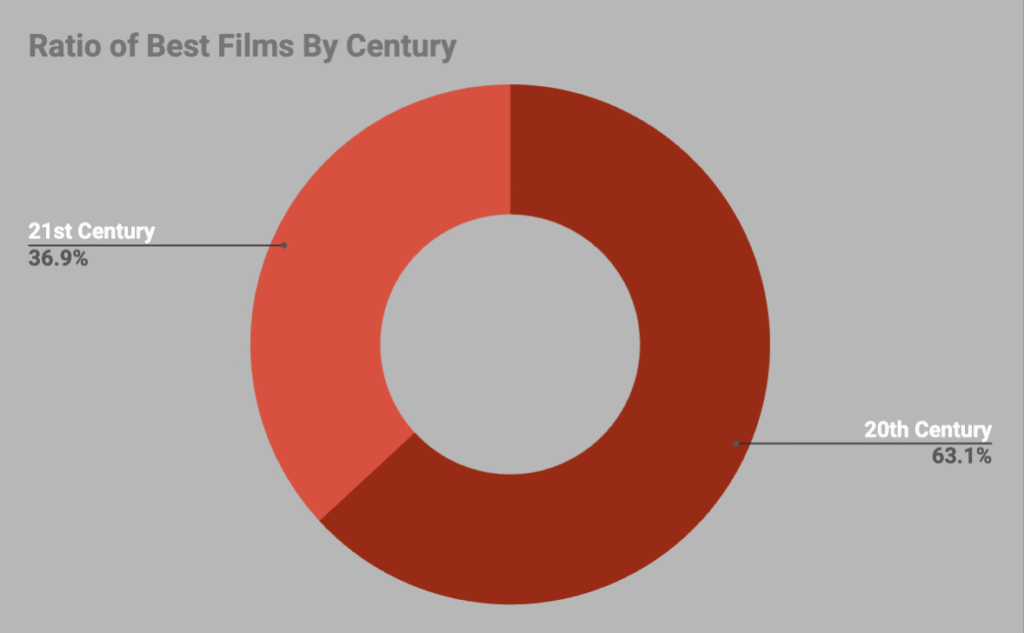
While 20th century films represent roughly two thirds of my list thus far, it’s 21st century films that are steadily expanding their share. From Marie Kreutzer’s Corsage to Jonathan Glazer’s The Zone of Interest and Nadav Lapid’s Synonyms, there’s been much to watch in the aughts, teens, and twenties. The doughnut chart below shows the ratio-in-progress of 20th century films to 21st century films in my list.
OTHER BEST FILM LISTS
Wikipedia: List of films considered the best
Refinery29: An Unpretentious Guide To The 101 Best Movies Of All Time
Time Out: The 100 best movies of all time
Letterboxd: Official Top 250 Narrative Feature Films
Sight and Sound: The Greatest Films of All Time
TSPDT: The 1,000 Greatest Films
TheCinemaholic: 100 Best Movies of All Time
MOVIE REVIEWS & ESSAYS
Criterion Collection: All films
Rotten Tomatoes: Certified Fresh Movies
Films Fatale: Art House Film Reviews
FILM FESTIVALS
Internationale Filmfestspiele Berlin
Toronto International Film Festival
Hong Kong International Film Festival
MOVIE STREAMING
(Beyond Netflix, Amazon Prime Video, Disney+, Hulu, Apple TV, Paramount+, Peacock, HBO Max, and Sling TV)